The first cold morning of the season often brings an unwelcome surprise: a tire pressure warning light on the dashboard. In many cases, the temperature drop is enough to lower tire pressure without creating a new leak. However, cold weather can also reveal existing tire wear, valve stem problems, or damage that should not be ignored.
Understanding why this happens can help you decide whether your tires only need air, a closer inspection, or new tires installation. For drivers searching for an auto mechanic in Bath, PA, a few simple checks can help protect handling, fuel economy, and winter driving safety.
Why tire pressure drops when the temperature falls
Air contracts as it gets colder. When the air inside a tire cools, it exerts less pressure against the tire’s inner walls. The tire has not necessarily lost air through a hole. The air has simply changed because of the lower temperature.
A commonly used rule of thumb is a pressure change of about 1 psi for every 10 degrees Fahrenheit of temperature change. This is an estimate, not a fixed physical constant. The actual change depends on the tire, its starting pressure, the outside temperature, and other conditions.
For example, a tire set to the correct pressure on a mild afternoon may show several psi less after sitting outside overnight during a cold snap. Driving warms the tire and the air inside it, which can raise the reading temporarily. That is why pressure should be checked when the tires are cold, preferably after the vehicle has been parked for several hours.
A warm tire may show a higher reading than it would in the morning. Do not release air from a warm tire just to match the cold pressure listed for your vehicle. Check it again when the tires are cold and adjust it then.
The correct tire pressure is on your vehicle, not the tire
The pressure printed on the tire sidewall is usually the tire’s maximum rated pressure, not the pressure your vehicle should normally use. For the correct setting, check:
- The placard on the driver’s door jamb
- The owner’s manual
- The vehicle manufacturer’s recommended specifications
The front and rear tires may require different pressures. Some vehicles also list a separate pressure for a fully loaded vehicle. Follow the information for your specific vehicle rather than using a general number.
Underinflated tires can wear faster along the outer edges. They may also reduce fuel economy and make steering or handling feel less predictable. Overinflated tires can wear more in the center of the tread and may create a harsher ride. Adding extra air is not a substitute for using the recommended pressure.
Check all four tires, including the spare if your vehicle has one. A noticeable difference between tires may point to a slow leak rather than a normal temperature-related pressure change.
Four tire checks to do this week
A pressure check is a good starting point, but it is not the only inspection your vehicle needs before colder weather arrives. These four checks can help you identify problems early.
1. Check and set tire pressure when the tires are cold
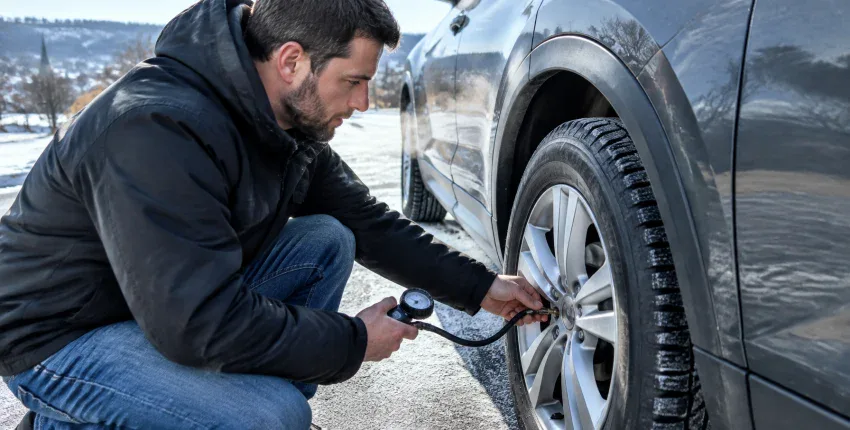
Use a reliable tire pressure gauge when the vehicle has been parked overnight or for at least several hours. If the tires have been driven only a short distance, they may still be warmer than the surrounding air and give a higher reading.
Set each tire to the pressure listed on the driver’s door jamb placard or in the owner’s manual. Do not use the maximum pressure printed on the tire sidewall as your normal target.
After adding air, replace the valve caps and check the reading again. If one tire repeatedly loses pressure while the others remain steady, arrange an inspection. A nail, screw, damaged valve stem, or rim sealing problem may be allowing air to escape slowly.
It is useful to check tire pressure regularly during fall and winter. Overnight temperature changes can affect the reading, and a small pressure loss can become more noticeable after several cold days.
2. Inspect tread depth and wear patterns
Tire pressure is only one part of winter driving preparation. Tire tread depth also affects traction on wet roads, snow, and slush.
Pennsylvania’s safety inspection standard generally requires at least 2/32 inch of tread depth in the required tread grooves for standard passenger vehicles. Tires at or near that limit may have limited remaining service life, especially when wet or icy conditions are possible. You can review the state’s inspection requirements through the PennDOT Vehicle Equipment and Inspection Regulations.
Look for these wear patterns:
- Wear on both outside edges, which may be related to low tire pressure
- Wear concentrated in the center, which may be related to excessive pressure
- Wear on only one edge, which can point to alignment or suspension concerns
- Cupping or scalloped sections, which may be related to suspension components or balance
- Uneven wear between tires on the same axle
A tread depth gauge gives a more accurate measurement than visual inspection alone. Treadwear indicators molded into the grooves can also show when a tire is reaching its replacement limit, but they do not identify every type of uneven wear.
Tire rotation can help promote more even wear when performed according to the vehicle manufacturer’s schedule. Rotation does not correct an alignment or suspension problem, so unusual wear should be investigated rather than simply moved to another wheel.

3. Inspect the sidewalls, valve stems, and wheel area
Walk around the vehicle and look closely at each tire. You do not need specialized equipment to spot several conditions that deserve attention.
Check the tire sidewall for:
- Bulges or bubbles
- Deep cuts or cracking
- Exposed cords
- Abrasion from contact with a curb
- Damage near the bead where the tire meets the wheel
Also look for nails, screws, or other objects in the tread. Do not remove an embedded object before the tire is inspected. Removing it may allow the tire to lose air more quickly.
The valve stem should be intact and free from visible cracking. A damaged valve stem or valve core can create a slow leak. The wheel area should also be checked for bends, corrosion, or damage that could prevent the tire from sealing correctly.
A tire that looks low again shortly after you add air should not be treated as a normal cold-weather issue. Seasonal temperature changes can lower pressure, but they do not explain a tire that continues losing air at a faster rate than the others.
4. Check the tire pressure monitoring system
Your vehicle’s tire pressure monitoring system, or TPMS, can alert you when one or more tires fall below the monitored pressure range. A TPMS light may come on during cold weather because the pressure has dropped enough to trigger the sensor.
When the light appears, verify the actual tire pressure with a gauge. Do not assume the sensor is wrong, and do not rely on the dashboard light as a replacement for regular pressure checks. The system may not tell you the exact pressure in every tire, depending on the vehicle.
After setting the tires to the recommended cold pressure, the light may need time or driving distance to turn off. Follow the reset instructions in the owner’s manual if your vehicle requires a reset. If the light stays on after the pressures are correct, the system or a tire may need further inspection.
A TPMS warning can sometimes draw attention to a slow leak that was not obvious during a visual check. Verify the pressure in all tires before driving any significant distance.
Tire pressure is not the only winter concern
Cold weather preparation should also include tire age and overall condition. Rubber can change over time, even when a tire still appears to have usable tread. Cracking, stiffness, and damage may become more noticeable as the tire ages.
Many tire manufacturers commonly recommend replacing tires around six to ten years from the date of manufacture, regardless of remaining tread. Guidance varies by manufacturer and vehicle use, so check your owner’s manual and the tire manufacturer’s recommendations. A professional inspection is especially useful for older tires, vehicles that sit for long periods, and cars used for frequent highway travel.
The DOT date code on the tire sidewall identifies when the tire was made. The final four digits usually show the production week and year. For example, a code ending in “2322” indicates production during the 23rd week of 2022. The full code may appear on only one side of the tire, so it may not be visible from outside the vehicle.
When new tires installation makes sense
New tires installation becomes the practical next step when the current tires no longer provide a safe amount of tread, have damage that cannot be safely repaired, or have reached an age where replacement is recommended.
Replacement may be appropriate when:
- Tread depth is at or near the Pennsylvania legal minimum
- Treadwear indicators are level with the surrounding tread
- The tire has exposed cords, a bulge, or significant sidewall damage
- A puncture is located in an area that cannot be safely repaired
- The tire repeatedly loses pressure
- Cracking or age-related deterioration is visible
- Uneven wear has reduced the usable tread on one section of the tire
If only one tire is damaged, replacement options depend on the vehicle’s drivetrain, tire type, and remaining tread on the other tires. Replacing tires in pairs or as a complete set may be recommended in some situations. A technician can compare the tires and explain the available options before work begins.
New tires should be balanced during installation. The vehicle’s wheel alignment should also be checked when the old tires show uneven wear, the vehicle pulls to one side, the steering wheel is off-center, or the vehicle recently struck a pothole or curb. Proper alignment helps the new set wear evenly. Suspension concerns may also need attention if the wear pattern is cupped, irregular, or concentrated on one edge.
Zeetailz, Inc provides tire and alignment services in Bath, PA for all makes and models. The family-owned shop is located at 6866 Chrisphalt Drive, Bath, PA 18014. The team can inspect tire pressure, tread depth, tire condition, rotation needs, balance, and alignment concerns, then explain the recommended service clearly.
A simple cold-weather tire routine
Before the next cold-weather commute, check the pressure in all tires while they are cold. Compare each reading with the driver’s door jamb placard. Then inspect the tread, sidewalls, valve stems, and wheel areas for signs of damage or uneven wear.
If the TPMS light appears, confirm the pressure with a gauge instead of ignoring it. If a tire loses air again, schedule an inspection. If the tread is worn, the tire is damaged, or the tires are aging, new tires installation may be safer and more practical than continued pressure adjustments.
For help with tire inspections, tire pressure concerns, wheel alignment, or new tires installation in Bath, PA, schedule an appointment with Zeetailz or call 484-246-7400. A cold-weather tire check now can help you begin the season with the pressure, tread, and condition your vehicle needs.